September 9, 2026
Communication Strategy
Time to Read:
5 minutes
Author:
John Aymes
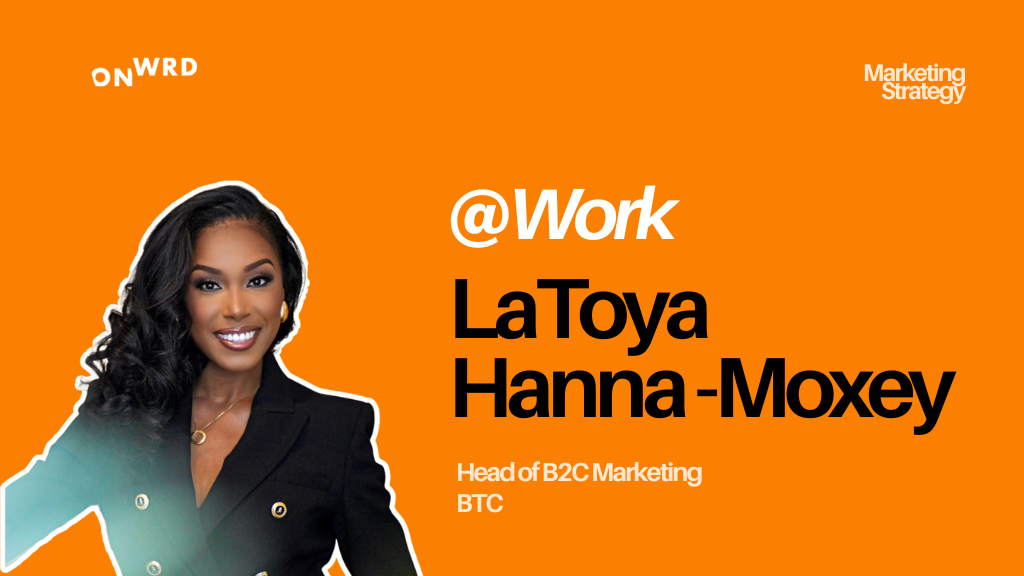
LaToya Hanna-Moxey is Head of B2C Marketing at BTC with a career footprint spanning telecommunications, hospitality, and healthcare. In our @Work conversation, Moxey explores how, in the age of digital transformation, marketers are no longer the people who dress things up at the eleventh hour but the ones who leverage tools like AI to help regional businesses bridge the critical gap between rapid technological advancement and real human connections.
The digital crossroads represents a strategic inflection point for regional competitiveness rather than a simple technical upgrade. For the Caribbean, and The Bahamas specifically, this transition is about moving from legacy systems to an innovation-led growth model that effectively removes the constraints of geography. Success in this new era requires more than adopting tools; it requires intentionally building a national digital identity.
OA: Looking at the broader landscape, the Caribbean market is evolving with unprecedented speed. What do you see as the single most significant opportunity for businesses in The Bahamas right now?
LM: We are standing at one of the most exciting crossroads in our history. For decades, our economy was anchored by tourism and financial services, but we are now seeing a profound shift toward innovation and digital transformation. The establishment of the Ministry of Innovation and National Development is a foundational realignment of our national priorities. It shows the government is thinking beyond traditional silos and investing in a future where entrepreneurs can scale their ideas globally.
OA: There is a perennial concern regarding whether we are moving fast enough. How do you evaluate our progress against regional peers like Barbados, Jamaica, or Trinidad?
LM: I don’t believe we are lagging; I believe we are pacing. There is a saying: "We’re new to this, not true to this." By being intentional, we can take a page out of the books of our regional counterparts who have already established digital footprints. This "second mover" advantage allows us to build a more resilient ecosystem, learning from their trajectories to develop our own competitive advantage. It’s not just about speed; it’s about the intentional construction of our national digital identity.
This national ecosystem provides the bedrock upon which marketing must now operate, shifting its focus from mere promotion to the strategic facilitation of trust.
In the era of digital transformation, consumer trust is the primary currency, and marketing is the department responsible for its minting. As organizations introduce complex systems—from digital wallets to e-governance—marketing must transcend the traditional role of "advertising products" to become the facilitator of adoption. Without a clear narrative that inspires confidence, even the most sophisticated innovation will fail to take root.
OA: You’ve argued that innovation is about improving how government serves people and how businesses operate. Where does marketing fit into that mechanical process?
LM: Marketing is the bridge between innovation and adoption. It is no longer enough to simply "make things look good." Our role is to help the public trust and embrace new systems—whether that is e-SIM technology, digital wallets, or online government services. When we build that trust, we effectively remove the geographical limitations that have historically hindered local entrepreneurs, allowing them to compete in any market, anywhere.
OA: So, the role is less about "selling" and more about "facilitating"?
LM: Exactly. Marketing has a responsibility to tell the story in a way that inspires confidence. We are the ones who help the public navigate the shift from the familiar to the future. If the consumer doesn’t trust the system, the technology is irrelevant.
As marketing moves into this role of facilitator, the process of building trust is being fundamentally redefined by the advent of Artificial Intelligence.
The rise of Artificial Intelligence has created a tension between logical automation and emotional resonance. However, the strategic opportunity of AI lies in its ability to act as a tool for scaling empathy. By utilizing AI to handle logical patterns and data-driven tasks, marketers are freed to provide the empathy, authenticity, and creativity that customers actually crave.
OA: Marketers often feel a sense of "imposter syndrome" when caught between technical leaders and business executives, especially with AI evolving so quickly. How should leaders be viewing these tools?
LM: I believe AI is an equalizer designed to elevate us, not replace us. It gives us the ability to analyze data and predict behavior at a level we’ve never seen. It’s about using the logic of the machine to better inform the emotion of the human. One of the questions I always ask my team is:
“How do we use AI to become more human, not less?”
OA: How does that "dance between emotion and logic" play out in a practical marketing strategy?
LM: AI is a logical tool, but humans are emotional by makeup. We let the AI handle the "heavy lifting"—the patterns and the analytics. This creates the bandwidth for the marketer to focus on the elements that truly connect: empathy, authenticity, and creative resonance. We are using the machine to understand the customer better so we can respond with more human energy.
This sophisticated use of high-tech tools must be grounded in the hard reality of business constraints, specifically the debate over marketing budgets.
There is a persistent myth that marketing impact is linearly tied to financial spend. In reality, strategic precision often outweighs brute financial force. High-impact marketing is born from a deep understanding of the audience's problems at the objective-setting phase, rather than the size of the checkbook at the launch phase.
OA: In your career across diverse sectors, what myths have you had to debunk regarding how marketing works at scale?
LM: The biggest myth is that bigger budgets create better marketing. I’ve seen marketing dollars decrease year over year, and while you need funds to be meaningful, success doesn't come from just pumping money into a campaign. It succeeds because we take the time to understand the audience’s problems and deliver a message that resonates.
OA: That seems to directly challenge the "fluff" perception of the marketing department.
LM: Marketing is often wrongly viewed as mere communication or the "fluff" that happens at the end of a project. But marketing actually begins at the objective-setting phase. When we map out the goal and figure out how to influence behavior to drive growth, we aren't just communicating—we are executing business strategy.
Moving from internal strategy to external execution requires a fundamental shift in how we handle the customer relationship, particularly when things go wrong.
In a hyper-connected digital world, brand loyalty is fragile. Traditional Public Relations often fails during service disruptions because it seeks to manage perception rather than provide accountability. To build resilient brands, businesses must shift to Human Relations—a framework centered on transparency and owning the narrative during moments of crisis.
OA: You’ve worked in high-stakes sectors like healthcare and hospitality. How do you maintain trust when the service fails?
LM: You cannot put lipstick on a pig or simply paint over the problem. We’ve seen this recently in the energy sector with bill shock and power disruptions, where the industry is essentially being slaughtered in the court of public opinion. In those moments, spin doesn't work.
“Customers don’t care about PR; they care about HR .”
OA: What does that "HR" approach look like when a company gets it wrong?
LM: It’s about accountability. I use the metaphor of a harmonic orchestra. When a service lapse occurs, the customer is making noise like a loud, crashing drum set. If I try to hide behind a PR campaign, I’m just adding to the noise. But if I bring my strings—which represent the solution, transparency, and accountability—suddenly we are playing the same song. We create harmony by listening and being honest, not by trying to create a false perception. I look back at the "Club Liaison" campaign at the British Colonial Hilton; it succeeded for 20 years because we made people feel valued and respected, not because we had a clever ad.
Achieving this level of strategic accountability requires marketers to evolve into a new kind of leadership mindset.
For marketers to move from the creative periphery to the strategic center of the boardroom, a professional evolution is required. To be an influential partner in revenue growth, the modern marketer must master the languages of finance and operations, ensuring they are never viewed as the weakest link in the room.
OA: What is your final directive for aspiring marketing leaders who want to gain influence in the boardroom?
LM: My advice is simple but difficult to execute:
“Stop thinking like a marketer. Start thinking like a business leader.”
LM: The boardroom isn't going to ask you how many likesa campaign generated. They want to know how you contributed to the growth of the company. You must develop financial literacy. You have to understand operations, customer acquisition, market share, and ROI. If you don't understand the key parts of the business message, you can't tell an effective story.
OA: You are essentially advocating for the marketer to become a multifaceted business operative.
LM: You have to be comfortable being uncomfortable. Learn AI, take a digital marketing course, and master the data. But through all that technical growth, remember the most important rule:
“To thine own self be true.”
Know a marketing executive we should feature? Get in touch with us.


July 20, 2026
Communication Strategy