October 15, 2026
Communication Strategy
Time to Read:
5 minues
Author:
AI can write the press release. It can't read the room.
There has never been more communications activity, or less reason to be impressed by it. With AI, a press release, a pitch deck and a week of social content are an afternoon's work. Which leaves every CEO and CMO with an uncomfortable question: is any of it moving the needle?
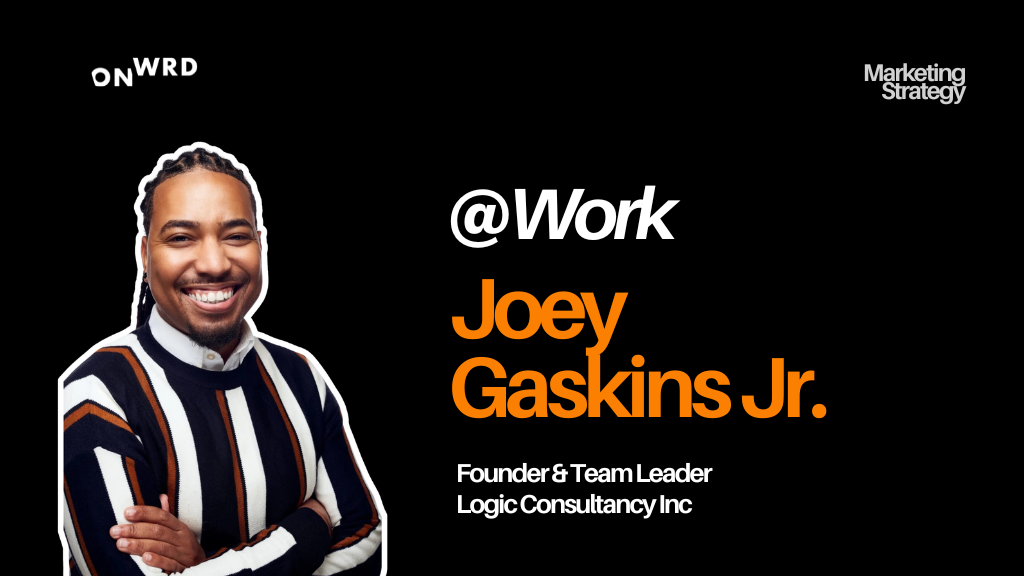
Joey Gaskins Jr. of Logic Consultancy has spent about two decades answering that question where the stakes are highest: foreign direct investment, legislation and major development in The Bahamas, including Disney's Lighthouse Point destination in Eleuthera, first as a consultant and then in-house.
In this edition of @Work, we sit down with Gaskins to talk outcomes over output, why Bahamians are nobody's monolith, and the one skill AI can't fake.
OA: Most people can't tell public affairs, communications, PR and marketing apart. Where do you draw the line?
JG: Marketing is about getting people to the point of sale. Communications is messaging, language and storytelling to different audiences. Public affairs has a stakeholder engagement element to it. That can be strategic communications, but also town halls, meetings with community members and government officials, one-on-ones, lunches. It's a very diverse toolbox.
The difference is that it's an exchange. You're sharing persuasive messaging, but you're also listening very closely and bringing what you hear back into the organization to change operations and planning. It's a negotiation between your external stakeholders and the organization you represent.
OA: You've worked both as a consultant and in-house. What separates activity from real influence?
JG: I'm a firm believer that influence accrues to those who get things done. There's a lot of talking in our industry, a lot of activity, but not a lot of focus on outcomes. You see it with the big consultancy houses: a set package delivered for every project. And AI makes that really easy right now. You can pump out a press release, a slide deck, website copy.
But the outcome is what matters most. It's not about producing assets. It's about which assets and which activities get the client where they want to be.
One of his first conversations with Disney was disarmingly blunt: "Do you want to be liked, or do you want to put cement in the ground?" Once the answer was clear (open the destination, and make it Bahamian-focused) everything else followed: the community engagement, the way the company communicated, the values it led with.
JG: You can put up all the content, be pretty on camera and share your thought leadership, and the marketing can be perfect. But the most important thing is to deliver the outcome for your client or your employer.
Before the next campaign, press release or post: does this move us closer to the outcome? If the answer is unclear, more activity is simply more noise.
OA: Before it opened, the Eleuthera project faced a vocal national campaign. Today it's creating real opportunity in the community. What should leaders take from that about public perception?
JG: Nature abhors a vacuum. Wherever you allow a story to be defined for you, that is exactly what will happen. And particularly here in The Bahamas, we have a really good BS detector, especially when it comes to people from outside the country.
So two principles govern me. First, go to people early, and don't go to sell a product. Go to listen. When you do speak, start with your values, not "look at the design of this beautiful project." That might be Bahamian inclusion, environmental responsibility, employment. Start there and build outwards.
Second, fill the vacuum. You don't have to say everything at once, but make sure people have a basis from which to understand you.
The lesson travels well beyond foreign direct investment. "Governments across administrations will drop a piece of legislation in Parliament and Bahamians will go, 'Wait, what's going on here?' There's a reason for consultation." Too often, he argues, organizations focus on cutting the ribbon without setting the stage for the announcement, a risky habit in small communities where rumors move at the speed of WhatsApp.
Royann likened the work to laying roads and plumbing before anything visible goes up. Gaskins took the analogy one step further.
JG: Before they do any infrastructure work, they do geotech. They map the territory. We have good resources for national polling, focus groups, qualitative and quantitative research. You use that data to inform strategy.
Then people get jittery when things aren't going exactly their way, and they veer off the agreed strategy. That's when you have to hold the line. Between echo chambers and a few very loud voices, you can be distracted by what you think you're hearing.
JG: It's not just getting agreement from the Member of Parliament or a couple of people in the community. It's talking to your friends and your enemies. It's talking to the uncertain. It's the bar and the church. It is the town hall, but it's also the lunch hall.
OA: How should Bahamian and regional organizations rethink their marketing and communications?
JG: One mistake people make is believing Bahamians are a monolith. "All Bahamians care about is jobs." You hear it all the time. But research shows that depending on class, education, even gender, people give precedence to different things.
Our goal as communicators is to tell the same story in different ways, in the most persuasive way, to the audiences that matter most.
What is your story? Who matters most to the outcome? What matters to them?
His example is pointed: for a project seeking approval, is the most important audience the wealthy environmentalist in Nassau, or the person marking "yes" on the approval?
JG: It's not just a science. The other part is relationships, especially in a place like The Bahamas, and I don't mean the envelope-in-the-back-pocket kind. Part of understanding people's true motivations comes through relationships. Part of carrying your message happens at a lunch table, at a bar or in a conference room, and to get into that conference room, you need relationships too.
OA: Promotions are short-term and quantitative. Communications and public affairs play a longer, more qualitative game. How do you hold that line with clients?
JG: Every client wants you to microwave success for them. But the kind of work that anchors your project into the future is done intentionally and authentically. It doesn't need to happen slowly, but it does need to happen methodically. Strategically is even better.
As a consultant, you can sell fast. But that's a dangerous game, because selling fast is selling activity and selling assets. I can get the graphics out, I can get the press release out tomorrow. But does that get you the outcome? That's the central question throughout.
Gaskins never studied marketing. He trained in political science and sociology, and studied discursive analysis, "the social science of understanding the way stories come to create reality around us." Fitting, for someone whose job is shaping the story before someone else does.
OA: What would you tell a young Bahamian who wants to do what you do?
JG: The most important skills are not the ones taught in school. Five or ten years ago, people would say learn how to write a press release. You do need to write, but writing comes from knowing how to think. Critical thinking, looking at the data, the newspapers and social media and synthesizing a story that helps your client understand the landscape, is more important than knowing how to write a press release.
Then emotional intelligence: understanding what's happening in a room. And empathy: stepping outside your own ideologies and standing in somebody else's shoes. Persuasion at its heart is empathy.
Those skills become more important in a world of artificial intelligence. Everybody's flyers look the same now, and day by day AI gets better at writing. But it cannot read culture. It can't understand the zeitgeist. It can't empathize. It cannot shake the hand and kiss the baby.
JG: A lot of people think communication is pushing information out. Content is king. Great. But how do you know your content is hitting? How do you know you're answering the questions that are actually being asked? Listening is the most important thing.
A lawyer on a recent project once asked him why people tell him everything. Her answer: "Because you're always ready to listen."
JG: Every bit of real communication is a two-way street.
Strip away the jargon and Gaskins' playbook is refreshingly simple: decide the outcome, map the ground, know who matters and listen harder than you talk. AI has made output cheap. Judgment, relationships and trust have never been more valuable, and that is exactly where the advantage now sits.
If your communications feel busy but aren't moving the outcome, that's the gap ONWRD's Brand Signal Check is built to find.
Listening: The Ezra Klein Show, Pivot, the Foreign Affairs Interview, The News Agents, Professor Scott Galloway and, a shared favourite, Monocle.
Reading: Ray Dalio's The Changing World Order, and Jonathan Franzen's essay collection How to Be Alone, his in-flight companion, "much more digestible" than a full book between meetings.
Public affairs combines strategic communications with stakeholder engagement. It shares information with communities, decision-makers and other stakeholders, and uses their feedback to shape an organization's planning and operations.
Marketing moves audiences toward a commercial action. Public affairs uses a broader toolbox (research, relationship building, consultation and two-way communication) to secure outcomes such as approvals, support and long-term trust.
Engage early, listen before persuading, lead with values rather than visuals, and use research to understand what different stakeholder groups actually care about.
AI accelerates content production, which makes strategy, critical thinking, empathy, cultural understanding, relationships and listening more valuable, not less.
Another ONWRD @Work conversation on digital transformation, marketing, AI and the human side of business.


July 20, 2026
Communication Strategy