July 14, 2026
Communication Strategy
Time to Read:
4 minutes
Author:
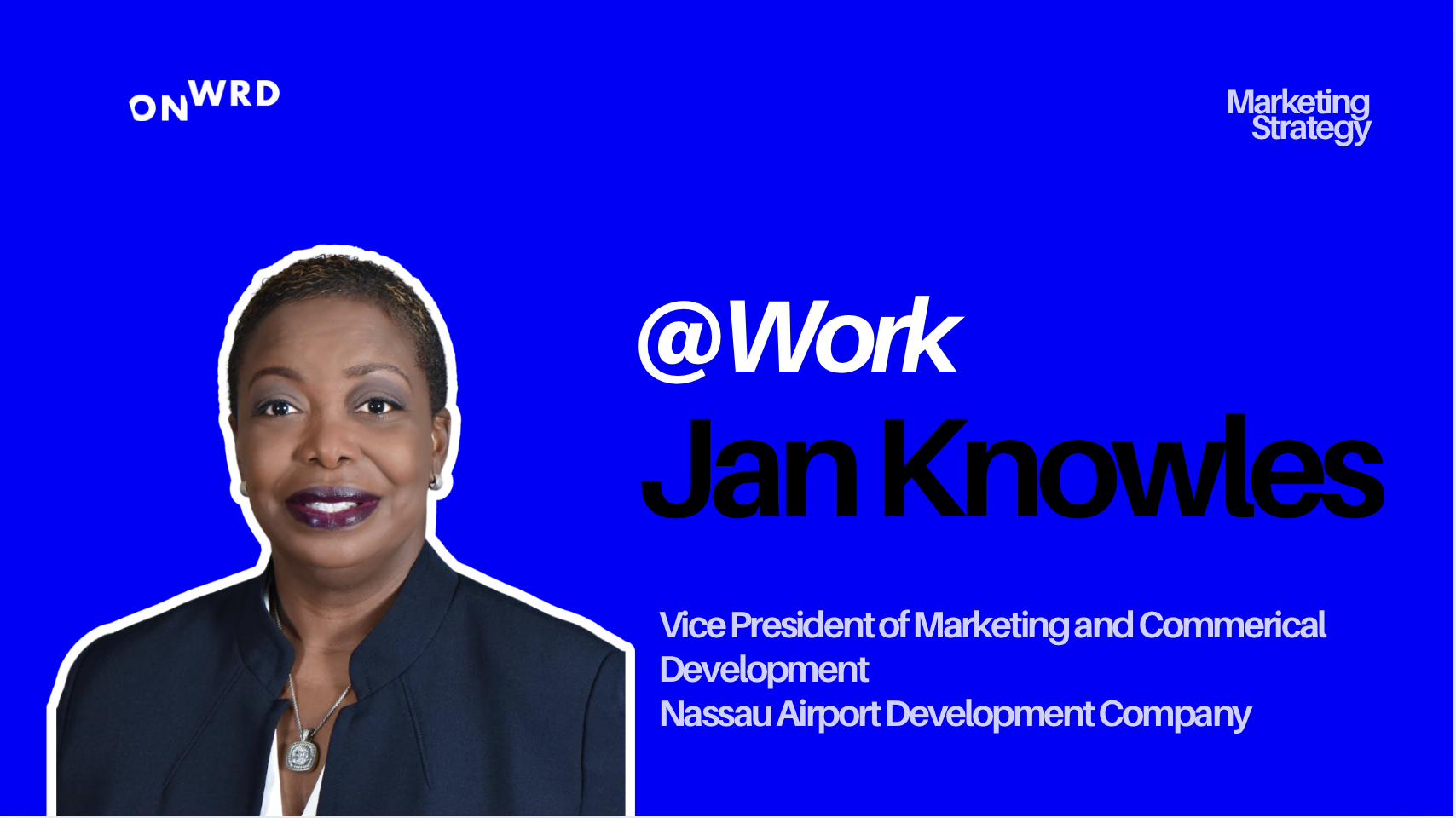
Lynden Pindling International Airport (LPIA) is one of the busiest gateways in the Caribbean and the first and last impression most visitors have of The Bahamas. Behind that experience is Nassau Airport Development Company, the operator running the airport as a self-sustaining business with no government subsidies. In this edition of @Work, our interview series featuring marketing and communications leaders from across The Bahamas and the Caribbean, we spoke with Vice President of Marketing & Commercial Development Jan Knowles about marketing across two very different audiences, building a brand that runs through 4,000 people, and why understanding the operations behind the airport is what earns marketers a seat at the table. Strong campaigns matter, but the real influence comes from knowing how the business works, who the customers really are and what data tells you about both. Her perspective shows how strategy, data, and a deep grasp of the business can turn marketing into a true revenue driver.
JK: It is quite different because in an airport environment, we serve two audiences. The first is more of a B2B situation. We have to market the airport and the destination to our airline partners, and that is a significant part of the marketing we do. We do that work in conjunction with the Ministry of Tourism and the Nassau Paradise Island Promotion Board.
The other side is our passengers. We are marketing to get them to use the services, food and beverage (F&B) and retail offerings that are inside the airport during the short window we have with them.
The success of all of that work is measured through air service development, passenger growth and what we call non-aeronautical revenue. It is not just about brand awareness. There is a lot going on commercially behind every initiative.
JK: Revenue generation is critical for every airport, and there are always two sides to it. Aeronautical revenue comes from the airlines and passengers through landing fees, jet bridge fees, passenger fees and so on. Non-aeronautical revenue comes from restaurants, retail, parking and other sources. Both sides matter, and they are connected.
COVID made that very clear. Our biggest revenue stream, passengers, stopped coming. So airports like LPIA and others around the world are now very focused on investments in complementary businesses that do not rely solely on passenger traffic.
We have developed a Landside Development Plan. Most airports have airside plans for runways, taxiways and cargo space. A landside plan looks at things like office space, hotels, shopping plazas or other complementary assets surrounding the airport. Some airports have even moved into advisory services and AI technology. The point is to have revenue streams that can sustain the business if passenger volume softens.
LPIA operates as a ‘going concern’. We do not receive government subsidies. We pay rent, business license fees and our own loans. So leadership clearly sees marketing and commercial development as part of how the business stays viable. That makes the conversation easier, because everyone is aligned on the fact that revenue diversification is not optional. It is how we keep the airport running.
JK: It is anchored in the brand experience, and we start by defining that experience clearly through our My LPIA program.
Our brand is our people. Training staff to deliver consistent and friendly service at a high level is the key. We have about 4,000 people working across what we call the airport community. That community is made up of a wide range of businesses and agencies, all with different goals and different priorities. We are the airport operator, but we also work with airlines, US pre-clearance, Bahamas Customs, Bahamas Immigration, retail tenants and many others. Every one of them touches the guest experience.
We started the My LPIA program in early 2025 with the objective of getting all 4,000 employees through the training. The goal is the prestigious Skytrax five-star rating for LPIA, and the training is designed to get everyone speaking one language and delivering service one way.
You can do nice signage, you can do plenty of other things, but the consistency comes from people. The friendly interaction. The "my pleasure." The "thank you." That is what holds a brand together across that many touchpoints.
We also measure constantly. A lot of our decisions are driven by the voice of our guests through surveys and real-time service level data. Whether we are making a capital investment or an operating decision, we want to make sure we understand what we need to deliver, because tourism is our main business.
JK: That broad, marketing-at-scale approach is not how we work. Everything we do is targeted. Whether it is our airline partners or our guests, it is a very focused approach.
When you sit in front of an airline and talk about Nassau, you have to understand their constraints. They only have so many planes. You have to understand their objective, which is to move those planes around and turn them around quickly. So when you pitch a route, it has to be useful for them. It has to be data-driven, with research showing it will generate the kind of revenue they are looking for. We bring airlines in carefully, one at a time, by understanding what each one needs.
On the guest side, we often share something key with our airport concession partners. A person coming to The Bahamas on vacation is someone who has money, because The Bahamas is a high-end destination. They are sophisticated. They have been to many ports and many airports. So whatever you offer them in your store has to be the right offer, with the right packaging and the right experience. Money is not the problem. The question is whether you have convinced them they want it.
That is why we focus on delivering a unique experience, which I call the Bahamian experience. They have to feel that only we can give them this. That comes from people who believe they are good enough, magical enough and different enough to deliver it.
JK: In an airport environment, it is less about budget pressure and more about balancing functionality with revenue generation.
There is always the functionality of providing space for seating. People have to be able to sit. They have to be comfortable. They have to feel a sense of well-being. But you also want space for retail, F&B and other experiences, because more square meters can mean more revenue. So the question becomes, where is the line? Where is it too much advertising or selling? Where does it become noise?
Do you want to be known as a noisy airport with advertising and shops everywhere, or an intentional airport that cares about the passenger and has thoughtful offers for them? That is the balance we work on every day.
A lot of it comes down to setting the stage. Some people have never been in your environment before, so you have to guide them. Early in the process, we let our guests know that no gate is more than a five-minute walk. That is not advertising. It is helpful messaging. But it changes the experience. Now they know they can hang around, browse, sit and enjoy themselves before heading to their gate. Without that information, they might just rush through to their gate and not engage with what is being offered from a retail or F&B standpoint.
Advertising and marketing should create an emotional connection. But the content also has to clearly show value and what the offer is. If people do not know what you have, they cannot engage with it. The work is in finding that balance.
JK: Always be prepared and well researched. Preparation is the foundation for credibility and influence.
Understanding the business you are in is also critical, especially the operational side and the real challenges the business faces. Marketers can work across all kinds of industries, but you cannot operate in a vacuum. If you do, some of what you put out will look tone-deaf. That is the last thing you want.
It is why I can speak fluently when we talk about wanting more shop space at a gate. I also understand what happens at that gate, why more seating is needed depending on the size of the aircraft and what the airline partners are managing. If a gate is coded for a certain aircraft size, I know that pushing for more retail space there is not a fight I am going to win, because the airlines need those seats. In a typical airport aeronautical revenue can be 50/50 with non-aeronautical revenue. Aeronautical revenue represented 70% of our business in FY2025.
Decisions have to be made based on data and information. You have to understand who you are marketing to and be able to communicate clearly.
You also have to be at the table. You have to understand the full context, including the historical context of the business. Even areas that may not feel like they have anything to do with you, listen carefully. Get involved. Go out into the field. Look around. Marketing is too connected to everything else for you to stay in your lane.
JK: I think the average traveler does not realize how complex it is to move a person and their bags from one airport to another. The number of people, systems and partners involved in processing a single passenger is significant.
A small thing I always tell people: take off the old luggage tags from your bag. Every one of them. There is something we call baggage hygiene, and those old tags are one of the things that can cause issues in the system. If your bag does not arrive when you do, the airline almost always knows where it is. It is rare for a bag to truly be lost. But the old tags do not help.
It is one of the reasons we are starting to think about behind-the-scenes content. People do not see the work that goes into running an airport, and there is real value in showing it. In the current AI environment, people appreciate seeing real people and real operations. Authentic content cuts through.
The same applies to AI itself. AI is here, and it is moving fast. My approach is to ask how it can work for me, not the other way around. We cannot depend on it to do the work. The question is how it helps us do the work better.
And then there is the bigger picture. Airports are economic drivers, especially for tourism. We are the first thing guests see and the last thing they experience in our country. This is something that we consider closely as we look at how LPIA expands in lockstep with the growth of our tourism product. There is also a direct correlation between airline seats and hotel rooms. When new rooms come into the inventory, airlines tend to add seats because there are now more rooms to fill. So when we sit down with airlines, we always tell them what is coming, what is being built, what has been announced. That kind of business intelligence is what they are looking for. It is what makes the conversation valuable.
That is what B2B airport marketing really comes down to, data and business intelligence.
If your team is working to position marketing as a true revenue driver, we can help.
Contact us to learn how ONWRD supports Caribbean businesses with strategic marketing and communication solutions.